
Most supply chain risk management is archaeology. Something breaks, and then we dig through the record to find out why: the supplier whose ownership changed two quarters ago, the factory that quietly moved production, the trade pattern that stopped making sense months before the shipment stopped arriving. The signals were almost always there. They were buried in volume no team could read in time.
That is the problem AI actually solves in this field. Not judgment. Prediction. Used properly, AI tools turn risk management from a reaction discipline into a forecasting one, and the shift is practical enough that a small team can run it. Here is how it works, step by step.
Step 1: Point the tools at leading indicators, not lagging ones. A late shipment is a lagging indicator; by the time it registers, the damage is scheduled. Leading indicators live earlier in the chain: ownership and management changes at a supplier, financial distress signals, export-control and sanctions list movement, unusual shifts in trade volumes or routing, new entities appearing in a supplier’s network, pricing that no longer matches the market. AI monitoring tools can watch those signals continuously across far more suppliers than any analyst team can track by hand. The discipline is in choosing the signals before you choose the tool. A tool watching the wrong indicators just produces faster noise.
Step 2: Let the model build the baseline, then flag the deviation. Prediction in this field rarely means forecasting an exact event. It means knowing what normal looks like, in enough detail that abnormal stands out. This is the work I have done recently with multi-model LLM workflows, using Claude, ChatGPT, and Gemini together under Human-in-the-Loop governance: the models read unstructured material, trade data, filings, news, ownership records, and build the picture of a supplier’s normal pattern. Then they flag what does not fit it. At Leidos, work of this kind supported 75 or more foreign investment risk assessments and surfaced more than 150 threat vectors inside critical infrastructure procurement, and it compressed review cycle times by 35 percent. The flag is not the finding. The flag is where a human analyst’s time is worth spending.
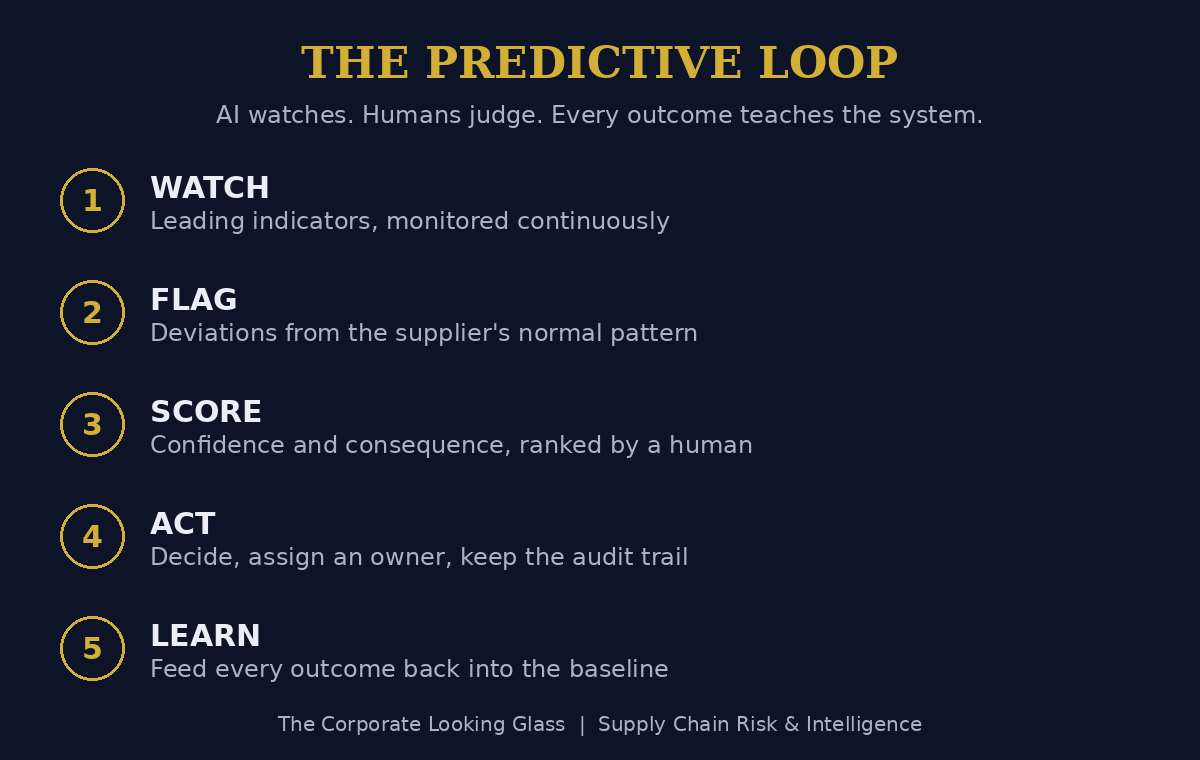
Step 3: Score the flag before anyone acts on it. Not every anomaly is a threat, and a system that cries wolf will be ignored by the third false alarm. Each flag needs a confidence level and a consequence level: how sure are we, and how much does it cost if it is real? High confidence and high consequence goes to the top of the queue today. Low confidence gets monitored, not escalated. This scoring step is where experienced judgment earns its keep, and it is the step vendors most often oversell as fully automatic. It is not. It should not be.
Step 4: Decide, act, and write it down. A prediction that does not change a decision is trivia. The output of this workflow is a short list of actions: qualify a second source, pull a shipment forward, increase a buffer, open a conversation with the supplier, or escalate to leadership with a recommendation. Every action gets a named owner and a record of what the model flagged, what the analyst concluded, and what was decided. That audit trail is not bureaucracy. It is what makes an AI-assisted decision defensible to a board, an auditor, or a regulator later.
Step 5: Feed the outcome back. Every flag resolves, one way or another: real threat, false alarm, or something in between. Recording the resolution is what turns a tool into a learning system. Over time the false alarms teach you which signals are weak in your supply base, and the confirmed threats teach you which ones to weight. Skip this step and you will have the same arguments about the same alerts every quarter.
What prediction cannot do
Three honest limits. First, the model is only as honest as the data under it. If your supplier master data is wrong, your item data is stale, or your tier-2 picture is a guess, the predictions inherit every one of those flaws, at machine speed. Second, AI predicts patterns, not intentions; a determined adversary adapts, which is why the human review is structural, not decorative. Third, a prediction is a probability, and leading on probabilities means sometimes acting on a threat that would not have materialized. That is still cheaper than reacting to the one that does.
Where to start
Start narrow. Pick one category, one region, or one critical supplier tier. Wire the monitoring to a handful of leading indicators you actually believe in. Run the flag-score-decide loop for one quarter and measure two things: how much earlier you saw trouble coming, and how many flags your team could genuinely work. Then expand. Prediction is a capability you build, not a product you install.
Here is my question for those of you running supply chains: what is the earliest warning signal you actually watch today, the one that has saved you before? Name it in the comments. I read every one, and the best answers will shape a follow-up post. If this way of thinking about risk is useful to you, follow along here. This is the work The Corporate Looking Glass does every week.